Don’t Get Scammed! Verify N35 vs N52 with a Gaussmeter
If you work with neodymium magnets—whether you’re a manufacturer, engineer, or buyer—you know this painful truth: Unscrupulous suppliers are passing off low-grade N35 magnets as high-grade N52, costing you thousands in rework, product failures, and missed deadlines. The worst part? N35 and N52 look exactly the same—no visual inspection can tell them apart. But here’s the good news: You can stop the fraud cold with a Gaussmeter for Magnet Grade, the only reliable tool for N35 vs N52 Verification. In this guide, we’ll break down the key differences, step-by-step verification methods, and why a gaussmeter is non-negotiable, with real data to help you protect your business.
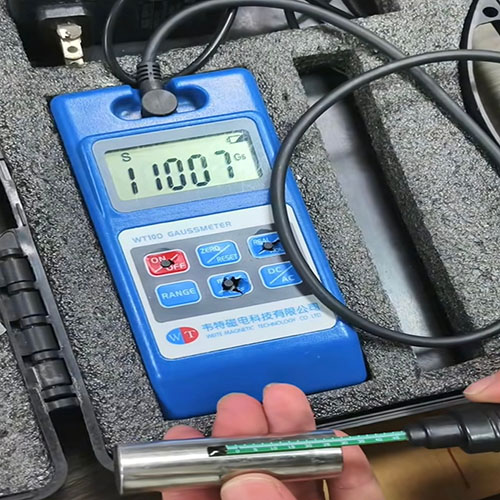
1. Key Difference: N35 vs N52 Surface Gauss Readings
To accurately distinguish N35 from N52, you first need to understand their core difference: surface gauss values. For magnets of the same size, N52 has a significantly higher gauss reading than N35. Below is a data comparison table (measured with a calibrated Gaussmeter for Magnet Grade) that clearly shows the standard ranges you need to reference, tested under standard conditions (20℃, no external magnetic interference, 10mm×3mm disc magnet, probe 0.1mm from the surface).
|
Magnet Grade |
Magnet Specification |
Typical Surface Gauss (G) |
Maximum Energy Product ((BH)max, MGOe) |
Verification Result (Gaussmeter Reading) |
|
N35 |
10mm×3mm Disc Neodymium Magnet |
11700 - 12100 |
35 |
≤12100G → Confirmed N35 |
|
N52 |
10mm×3mm Disc Neodymium Magnet |
14600 - 14800 |
52 |
≥14600G → Confirmed N52 |
|
Mislabeled N35 (Passed as N52) |
10mm×3mm Disc Neodymium Magnet |
11900 - 12000 |
35 |
11900-12000G → Fraud Identified |
2. Step-by-Step: Verify N35 vs N52 with a Gaussmeter
Once you know the gauss value ranges, performing a reliable Neodymium Magnet Grade Test is straightforward. Follow these 4 simple steps with your Gaussmeter for Magnet Grade to avoid scams: First, calibrate your gaussmeter with a certified reference magnet—uncalibrated devices give misleading readings, rendering your test useless. Second, place the magnet on a non-magnetic surface (such as plastic or wood) to avoid external interference, which can skew results by up to 10%. Third, hold the probe 0.1mm from the magnet’s surface (the optimal position for accuracy) and take 3-5 readings from different spots, as magnetic fields are not perfectly uniform. Finally, compare your average reading to the table above: ≤12100G means it’s N35, ≥14600G means it’s N52, and any reading in between indicates fraud or low quality.
3. Why Gaussmeter for Magnet Grade Is a Must-Have
A Gaussmeter for Magnet Grade is not just an optional tool—it’s your best defense against fraud and costly business losses. The benefits are tangible: you’ll avoid purchasing mislabeled magnets, ensure your products meet performance standards (N52 is 49% stronger than N35 of the same size), reduce rework and replacement costs, and build trust with your customers. Whether you’re buying magnets in bulk or testing in-house production, N35 vs N52 Verification with a gaussmeter is fast, portable, and affordable—no complex lab tests required. It’s a low-effort, high-impact step that directly protects your bottom line.
Xiamen kings magnet Co., Ltd. specializing in the customization and production of magnetic materials and magnetic components, provides professional design solutions, welcome to consult!
FAQ
Q1: Can temperature affect gaussmeter readings during N35 vs N52 Verification?
A2: Yes—neodymium magnets lose about 0.13% of their magnetic strength per ℃ above 20℃. To ensure accuracy, perform the Neodymium Magnet Grade Test at 20±2℃. If testing in extreme temperatures, adjust readings accordingly (e.g., a 30℃ reading of 14400G for N52 is equivalent to 14582G at 20℃).
Q2: Why do some N52 magnets have slightly lower gaussmeter readings than the standard range?
A3: Minor variations (±100G) are normal due to manufacturing tolerances. However, if readings are consistently below 14600G, the magnet is likely mislabeled (N48 or N50 passed as N52) or has quality issues. Use a Gaussmeter for Magnet Grade to confirm and avoid accepting substandard products.